
In the chess game of modern warfare, where hypersonic missiles streak across the stratosphere and stealth aircraft exploit radar blindspots, one system has emerged as a formidable guardian of sovereign airspace. The S-400 Triumf, Russia’s most advanced air defense system, represents not merely an incremental improvement over its predecessors, but a paradigm shift in how we conceptualize integrated air defense. For the discerning technical audience, its true fascination lies not in geopolitical headlines, but in the elegant synthesis of radar physics, missile kinematics, and networked command-and-control architecture that makes it such a compelling subject of study.
The Multi-Frequency Radar Mosaic: Seeing Through the Fog
At the heart of the S-400’s capability is its sophisticated multi-frequency radar architecture. Unlike single-band systems that adversaries can exploit through frequency-specific countermeasures, the S-400 employs a layered approach using X-band, S-band, and L-band radars operating in concert. The 91N6E “Big Bird” search and acquisition radar operates in S-band (2-4 GHz), providing exceptional long-range detection up to 600 kilometers for large targets. Its lower frequency allows it to detect stealth aircraft more effectively than higher-frequency radars, as stealth coatings optimize primarily for X-band frequencies.
The 92N6E fire control radar switches to X-band for precision tracking and targeting, leveraging its shorter wavelength for superior angular resolution. This frequency diversity creates a dilemma for electronic warfare systems: jamming strategies optimized for one frequency band become less effective against others. The physics here is elegant longer wavelengths suffer less atmospheric attenuation but provide lower resolution, while shorter wavelengths offer precision at the cost of range and weather sensitivity. The S-400’s designers understood that optimal defense requires choosing the right tool for each phase of engagement.
Missile Diversity: A Quiver of Specialized Arrows
Perhaps the most innovative aspect of the S-400 is its multi-missile capability. The system can simultaneously employ four different missile types, each optimized for specific engagement scenarios:
The 40N6E missile pushes the envelope of long-range interception, capable of engaging targets at ranges up to 400 kilometers and altitudes reaching 185 kilometers. This places satellites and high altitude reconnaissance platforms within its reach a capability that blurs the traditional boundary between air defense and antisatellite operations. The missile employs a semi active radar homing system combined with inertial navigation, allowing it to engage targets beyond the radar horizon through datalink updates.
For medium-range engagements (250 km), the 48N6E3 provides the workhorse capability. This two-stage missile accelerates to Mach 6, generating over 20g of lateral acceleration for terminal maneuvering sufficient to intercept even highly agile targets. Its active radar seeker autonomously guides the missile in the terminal phase, reducing the fire control radar’s burden and allowing simultaneous engagement of multiple targets.
The 9M96E2 medium-range missile (120 km) incorporates an innovative gas-dynamic control system using lateral thrust jets rather than aerodynamic control surfaces. This enables extreme maneuverability even at low speeds and high altitudes where conventional control surfaces lose effectiveness. The result is a hit-to-kill capability against cruise missiles and aircraft throughout the engagement envelope.
Finally, the short-range 9M96E (40 km) provides point defense with the same advanced maneuvering system, creating a dense protective bubble around high value assets. Each launcher can carry up to 16 of these compact missiles, dramatically increasing the number of ready-to-fire interceptors.
Network-Centric Warfare: The Distributed Intelligence
Modern air defense is no longer about isolated systems defending fixed positions. The S-400’s true strength emerges when deployed as part of an integrated air defense network. Its 55K6E command post can coordinate with other S-400 batteries, S-300 systems, Pantsir short-range systems, and even fighter aircraft through secure datalinks. This creates a layered defense where each system compensates for others’ limitations.
The networking architecture follows NATO’s recognized air picture (RAP) principles, fusing data from multiple sensors to create a unified operational picture. Track association algorithms correlate detections from different radars, filtering out false contacts and improving track accuracy. When one radar is jammed or disabled, others seamlessly fill the coverage gap. This distributed intelligence makes the network far more resilient than the sum of its parts destroying a single node degrades but doesn’t eliminate the system’s effectiveness.
The command post employs sophisticated engagement algorithms that optimize missile allocation across the network. If a high value target enters range of multiple batteries, the system automatically assigns the battery with the highest probability of kill while ensuring other batteries remain available for subsequent threats. This dynamic targeting requires solving complex optimization problems in real time a testament to the processing power available in modern defense systems.
The Physics of Engagement: Solving the Intercept Triangle
Every successful intercept reduces to solving the geometric problem of the pursuit curve. For a missile traveling at velocity Vm to intercept a target moving at Vt, the intercept geometry depends critically on the speed ratio. The S-400’s Mach 6+ missiles provide a speed advantage of 2-4× over most aircraft, translating to much larger intercept envelopes. This speed margin is crucial for engaging maneuvering targets the faster your interceptor, the less predictive accuracy you need about target trajectory.
Terminal guidance presents its own challenges. Active radar seekers must maintain lock while experiencing violent g-forces and potential electronic countermeasures. The S-400’s missiles employ frequency agile seekers that hop between frequencies to counter spot jamming, while signal processing algorithms filter out chaff and other decoys based on radar cross-section characteristics and kinematic behavior. These algorithms represent decades of refinement distinguishing true targets from sophisticated decoys remains an active area of research.
Operational Mobility: Defense in Motion
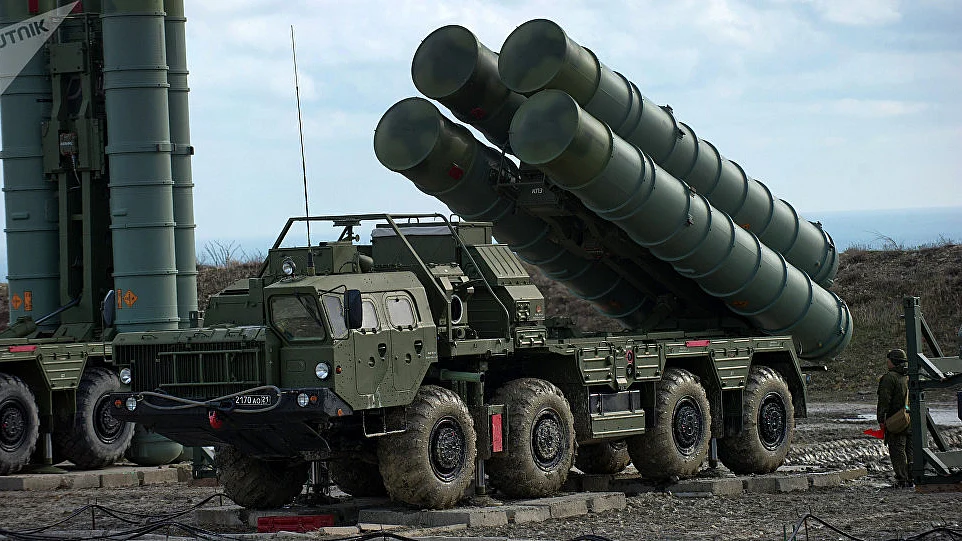
Unlike fixed SAM sites vulnerable to precision strikes, the S-400 achieves full operational capability within five minutes of arriving at a new position. Each battery comprises multiple 8-wheeled TEL (Transporter Erector Launcher) vehicles that can traverse rough terrain and deploy independently. The command post, radar systems, and launcher vehicles can spread across several kilometers, complicating targeting and requiring adversaries to expend multiple precision munitions to neutralize a single battery.
This mobility transforms tactical possibilities. A battery can defend a high value target during vulnerable periods, then relocate before enemy strike assets can respond. The short setup and teardown times enable a “shoot and scoot” doctrine where batteries appear, engage targets, and disappear before counter-battery fire arrives. GPS-aided inertial navigation ensures accurate positioning for the radar systems, while automated alignment procedures eliminate time-consuming manual setup.
Countermeasures and Counter-Countermeasures: The Eternal Spiral
No system operates in isolation from adversary responses. Against the S-400, potential countermeasures include stand-off jamming, anti-radiation missiles, saturation attacks, and stealth penetrators. Modern electronic warfare systems can generate false targets or mask true ones through deceptive jamming. High-speed anti-radiation missiles like the AGM-88E AARGM can home on radar emissions and destroy the search radars.
The S-400’s designers anticipated these threats. The radars operate in low probability of intercept (LPI) modes using frequency hopping and low peak power to minimize their electromagnetic signature. The system can engage anti-radiation missiles using its short-range missiles before they reach the radar. Multiple radar systems provide redundancy suppressing one doesn’t blind the entire battery. Perhaps most importantly, the networking capability means individual batteries can receive targeting data from distant sensors, engaging threats while keeping their own radars silent.
Against saturation attacks, the mathematics become unforgiving. Each launcher carries a finite number of missiles, and salvo doctrine requires allocating multiple interceptors per target to ensure high probability of kill. A coordinated attack with dozens of cruise missiles and decoys can overwhelm even sophisticated defenses. This reality drives layered defense concepts the S-400 provides the outer shield, while shorter-range systems like Pantsir handle leakers that penetrate the first layer.
The Technological Watershed
What makes the S-400 historically significant isn’t any single revolutionary technology it’s the integration of mature technologies into a coherent, network-centric system that marks a generational leap. Previous systems like the S-300 were formidable but fundamentally point defense weapons. The S-400 transforms air defense into an area denial strategy where a single battery can influence airspace hundreds of kilometers distant.
This capability has profound strategic implications. Nations deploying S-400 systems can credibly threaten aircraft, cruise missiles, and even theater ballistic missiles across vast swaths of airspace. This shifts the burden to adversary air forces, who must now employ sophisticated suppression campaigns, stand-off weapons, and stealth assets rather than conventional strike aircraft. The economic calculus changes dramatically when each defended target requires tens of millions of dollars in supporting capabilities.
Looking Forward: The Next Evolution
As impressive as the S-400 is, it represents a technology frozen in the early 2010s. The next generation of threats hypersonic glide vehicles, swarming drones, directed energy weapons will challenge even this advanced system. Russia’s S-500 Prometey aims to address some of these limitations with improved sensors and faster missiles, while other nations pursue their own advanced systems.
For the technical community, the S-400 offers valuable lessons in systems engineering. Its success stems from understanding that modern warfare requires not individual super-weapons but integrated systems where components complement each other’s strengths. The multi frequency radars, diverse missile types, network-centric architecture, and operational mobility each address specific vulnerabilities that would cripple a more narrowly optimized system.
As defense technologies continue their relentless evolution, the S-400 stands as a milestone not as an endpoint, but as a demonstration of what becomes possible when sophisticated sensors, kinetic interceptors, and digital networks merge into a unified whole. For students of military technology, it provides a rich case study in how seemingly incremental advances in radars, missiles, and computing can combine to create genuinely transformative capabilities. And for those of us fascinated by the technical challenges of air defense, it offers endless opportunities to appreciate the elegant engineering solutions required to hit a bullet with another bullet, across hundreds of kilometers of atmosphere, in the face of determined countermeasures.
The age of isolated air defense islands has ended. The future belongs to networked systems that can see farther, react faster, and adapt more effectively than ever before. The S-400 Triumf may well be remembered as the system that showed us that future was already here.
• • •
S-400 Technical Specifications at a Glance
Maximum engagement range: 400 km (40N6E missile)
Maximum engagement altitude: 185 km
Radar detection range: 600 km for large targets
Target engagement capacity: 36 targets simultaneously
Missile velocity: Up to Mach 6+ (2.1 km/s)
Setup time: 5 minutes to operational readiness
Reaction time: 9-10 seconds from detection to launch
Crew: Highly automated; minimal personnel required