
Inside the most powerful explosion in human history and why we’ll never see another one like it
On the morning of October 30, 1961, two Russian pilots climbed into a heavily modified Tu-95 bomber on an Arctic island so remote that few maps bothered to include it. Their aircraft carried a weapon so massive it couldn’t fit inside the bomb bay. Instead, it hung partially exposed beneath the fuselage like some grotesque metallic egg, painted white to reflect the thermal pulse that would soon try to vaporize everything within a hundred-kilometre radius including them.
The pilots knew their survival odds weren’t great. Even with a massive parachute to slow the bomb’s descent, even with every second of escape time the engineers could buy them, the mathematics were unforgiving. They would need to be 45 kilometres away when the device detonated at 11:32 Moscow time. That meant flying their heavy bomber, already straining under an impossible load, at maximum speed for precious minutes while a 27-ton thermonuclear weapon descended toward the frozen Arctic below.
What happened next would never be repeated.
A Weapon Too Terrible to Use
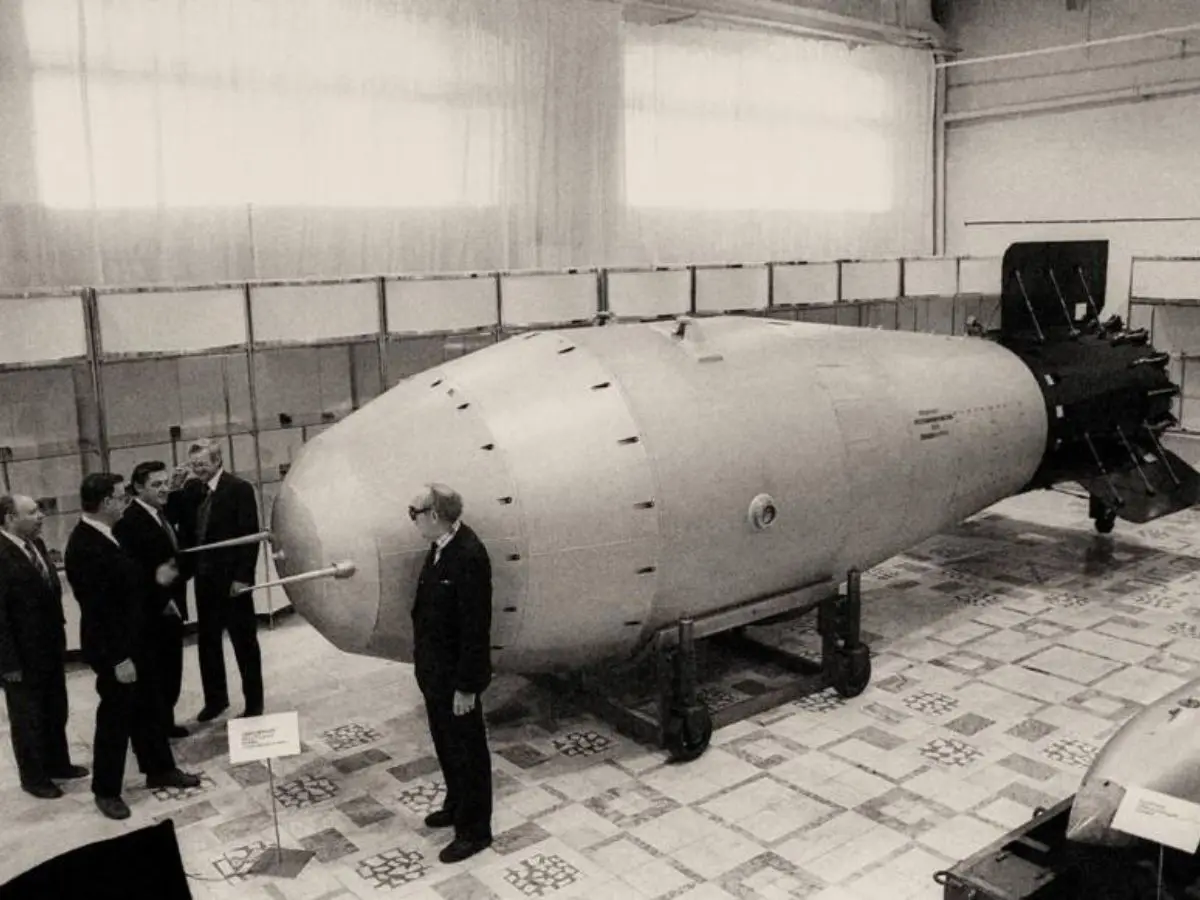
The RDS-220 quickly nicknamed Tsar Bomba, or “King of Bombs” wasn’t designed to win wars. By the time Soviet physicists led by Andrei Sakharov completed its development, everyone involved understood that a 50-megaton thermonuclear device had limited practical military value. The weapon was simply too big, too heavy, and too devastating. No standard bomber could carry it. No silo could house it. Its blast radius meant that conventional tactical deployment was nearly impossible without sacrificing the delivery crew.
So why build it? The answer lay not in military strategy but in the psychology of the Cold War. Just months earlier, the Bay of Pigs invasion had failed spectacularly. The Berlin Crisis was escalating. And while Yuri Gagarin’s orbital flight had given the Soviet Union a propaganda victory, Premier Nikita Khrushchev wanted something more visceral, more immediately terrifying. He wanted the world to see quite literally that the Soviet Union could unleash destruction on a scale that defied comprehension.
The original design called for a 100-megaton yield. But even Soviet physicists, no strangers to ambitious weapons projects, balked at the implications. A 100-megaton device would produce catastrophic fallout, spreading long-lived radioactive isotopes across vast swaths of the Northern Hemisphere. The political ramifications would be severe. More importantly, the scientists themselves were growing increasingly uneasy about atmospheric nuclear testing.
So, they made a fateful modification. The third stage of the weapon, originally designed with a uranium-238 tamper that would undergo fast fission and roughly double the yield, was instead fitted with lead. This change effectively cut the explosive power in half while simultaneously eliminating 97% of the potential radioactive fallout. As tested, the Tsar Bomba was one of the “cleanest” nuclear weapons ever detonated 97% of its energy came from fusion rather than fission.
That such considerations were even possible speaks to the surreal calculations of the atomic age: how to build a weapon of apocalyptic power that was somehow responsible.
The Flash Heard Around the World
At precisely 11:32 Moscow time, over the Mityushikha Bay testing range at Novaya Zemlya, the Tsar Bomba detonated 4,000 meters above the frozen Arctic landscape.
The fireball that erupted measured eight kilometres in diameter nearly five miles of superheated plasma with surface temperatures reaching millions of degrees Celsius. For a brief moment, a second sun blazed in the Arctic sky, visible from over 1,000 kilometres away. Observers in Norway, accustomed to the aurora borealis, reported that this light was different sharper, more terrible, painful to look at even from impossible distances.
The thermal pulse alone was sufficient to cause third-degree burns to exposed skin 100 kilometres from ground zero. At that distance, in the instant before the shockwave arrived, combustible materials simply ignited. The radiant heat was intense enough to be felt on skin 270 kilometres away, according to reports from monitoring stations.
But the thermal effects, devastating as they were, paled in comparison to the blast wave. The initial shockwave travelled outward at supersonic speed, flattening everything in its path. Wooden houses were obliterated out to 55 kilometres. Stone buildings suffered severe damage at 100 kilometres. Windows shattered across Norway and Finland, some as far as 900 kilometres from ground zero. In the town of Dickson, nearly 800 kilometres away, the blast wave was powerful enough to crack concrete and damage infrastructure.
The atmospheric pressure wave didn’t stop at regional boundaries. It circled the entire Earth three times before finally dissipating. Seismologists worldwide initially interpreted their instruments’ readings as a major earthquake, registering between 5.0 and 5.25 on the Richter scale. Barometric sensors detected the pressure wave making its planetary circumnavigations over the course of several days.
And then there was the mushroom cloud.
Touching the Edge of Space
Nuclear weapons produce mushroom clouds through a well-understood mechanism: the intense heat of the fireball causes rapid expansion of air, which rises with tremendous force, drawing debris and particulates upward in its wake. The height a mushroom cloud reaches depends on the yield of the weapon and the composition of the fireball.
The Tsar Bomba’s cloud reached 64 kilometres into the atmosphere.
To put this in perspective: commercial airliners cruise at 10-12 kilometres. Mount Everest stands at 8.8 kilometres. The stratosphere, where ozone absorbs ultraviolet radiation and temperature increases with altitude, extends to about 50 kilometres. The Tsar Bomba’s mushroom cloud punched through the stratosphere entirely and penetrated deep into the mesosphere, the layer of atmosphere where meteors burn up and temperatures plummet to -90°C.
The cloud’s cap flattened as it reached altitudes where atmospheric density becomes vanishingly thin. At 64 kilometres, the boundary between atmosphere and space is close enough that atmospheric dynamics begin to behave in unexpected ways. The cloud’s base was so wide 30 kilometres in diameter that observers struggled to comprehend its scale. It looked less like a mushroom and more like a cosmic jellyfish, pulsing with thermal currents that defied the normal constraints of weather and wind.
The relatively “clean” fusion reaction meant the cloud contained less heavy particulate matter than a dirtier weapon would have produced, allowing it to rise even higher than theoretical models predicted. Atmospheric scientists studying the event noted that the thermal buoyancy was sufficient to overcome temperature inversion layers that typically limit vertical mixing in the stratosphere.
The Pilots Who Survived
Back in the Tu-95, the crew had problems.
Despite executing their escape manoeuvre perfectly, despite being at the maximum possible distance achievable given the weapon’s descent time, the bomber was still too close. The thermal pulse painted the aircraft’s white exterior with enough heat to cause severe discomfort inside the cockpit. Then came the shockwave.
The blast wave hit the Tu-95 like an invisible freight train. The aircraft dropped a thousand meters in altitude almost instantly, the pilots fighting desperately to maintain control as their bomber was tossed about like a toy. Metal groaned. Instruments spun wildly. For several terrifying seconds, the crew wasn’t sure they would maintain controlled flight.
But they did. The pilots managed to stabilize the aircraft and, still shaking from both the physical buffeting and the psychological impact of what they’d just witnessed, turned toward home. Both would be awarded the Hero of the Soviet Union medal. Both would survive to old age, carrying with them the knowledge that they had delivered the most powerful weapon ever detonated.
The observer aircraft, flying at a safer distance, captured film footage that would become iconic. The sheer scale of the explosion is difficult to convey even in motion pictures. The fireball looks impossibly large. The mushroom cloud appears to be rising in fast-forward, though the footage is real-time. It is the physics of the event itself that seems unreal.
The Mathematics of Destruction
Here’s what makes the Tsar Bomba so remarkable from a physics standpoint: it demonstrated the ultimate limits of yield-based weapons design.
Nuclear weapons don’t scale linearly. A bomb twice as powerful doesn’t create twice the destruction. Instead, blast radius follows a cube-root relationship with yield. A 50-megaton weapon has a blast radius only 3.7 times larger than a 1-megaton weapon, despite requiring 50 times the fissile material and producing 50 times the energy.
From a military standpoint, this makes ultra-high-yield weapons inefficient. Ten 5-megaton warheads distributed across ten cities would cause far more cumulative destruction than one 50-megaton weapon on a single city. The Tsar Bomba’s test essentially proved this principle experimentally which is probably why no one has ever tried to build another one.
For comparison, the bomb dropped on Hiroshima, “Little Boy,” had a yield of approximately 13 kilotons. The Tsar Bomba was 3,846 times more powerful. It exceeded the total combined explosive yield of all conventional weapons used in World War II, including both atomic bombs dropped on Japan, by a factor of roughly ten.
The energy released 50 megatons of TNT equivalent, or 2.1 × 10¹⁷ joules was approximately 1.4% of the total solar energy received by Earth in one second. For a brief moment, humanity created a source of energy and destruction that could be measured as a percentage of the sun’s output.
Sakharov’s Regret
Andrei Sakharov, the lead physicist behind the Tsar Bomba’s design, would later undergo a profound transformation. In the years following the test, he became increasingly vocal about the dangers of nuclear weapons and the arms race. By the 1970s, he had become one of the Soviet Union’s most prominent dissidents, advocating for human rights and nuclear disarmament at great personal cost.
In his memoirs, Sakharov wrote with evident regret about his role in nuclear weapons development. He described a banquet following the Tsar Bomba test where he proposed a toast suggesting that their weapons should never be used. A Soviet general reportedly responded: “We are soldiers, and our job is to follow orders. Let us drink to ensuring our weapons are never unused!” The disconnect between scientific conscience and military doctrine was complete.
Sakharov would go on to win the Nobel Peace Prize in 1975 for his advocacy work, though the Soviet government prevented him from traveling to Oslo to accept it. He was eventually exiled to Gorky (now Nizhny Novgorod) where he lived under constant surveillance until Mikhail Gorbachev allowed him to return to Moscow in 1986.
His transformation from weapons designer to peace activist mirrored a broader shift in scientific consciousness. Many physicists who had worked on nuclear weapons programs in the 1940s, 50s, and 60s later expressed similar regrets. J. Robert Oppenheimer’s famous quote “Now I am become Death, destroyer of worlds” after the first atomic test in 1945 captured this moral reckoning, but Sakharov’s journey was perhaps even more dramatic because it required actively opposing the government he had once served with such distinction.
The Treaty That Followed
If the Tsar Bomba was meant to intimidate the West and demonstrate Soviet power, it succeeded but not in the way Khrushchev intended. The test appalled people worldwide, including many within the Soviet Union itself. The sheer scale of the explosion, combined with growing scientific understanding of radioactive fallout and its long-term health effects, galvanized international public opinion in favour of limiting nuclear testing.
Less than two years after the Tsar Bomba test, the United States, Soviet Union, and United Kingdom signed the Partial Test Ban Treaty in August 1963. The treaty prohibited nuclear weapons tests in the atmosphere, outer space, and underwater. Underground testing would continue for decades the U.S. didn’t conduct its last underground test until 1992, and the Soviet Union until 1990 but the era of massive atmospheric detonations was over.
In this sense, the Tsar Bomba may have paradoxically contributed to nuclear restraint. By demonstrating the extremes of what was possible, it helped clarify what was advisable. The weapon’s impracticality as an actual tool of war, combined with the visceral horror of its effects, reinforced the argument that nuclear weapons were qualitatively different from conventional arms and required international cooperation to manage.
Why We’ll Never See Another One
Modern nuclear arsenals contain nothing like the Tsar Bomba. Current strategic warheads typically range from 100 to 500 kilotons, with some reaching several megatons. This isn’t because we’ve lost the technical capability to build larger weapons the physics and engineering are well understood. Rather, it’s because military strategy has evolved to recognize that smaller, more accurate, multiple warheads provide better strategic value.
The advent of MIRVs Multiple Independently targetable Re-entry Vehicles—meant that a single missile could carry numerous smaller warheads, each capable of hitting a different target with far greater precision than was possible in 1961. Why drop one 50-megaton bomb on a city when you can distribute ten 500-kiloton warheads across ten cities, each guided to its target with GPS-level accuracy?
Furthermore, international treaties have created a political and legal framework that makes ultra-high-yield weapons development extremely difficult to justify. The Comprehensive Nuclear-Test-Ban Treaty, signed in 1996 (though not yet in force), prohibits all nuclear explosions, for any purpose. While several nations have not ratified the treaty, including the United States, there is broad international consensus that the age of atmospheric nuclear testing should remain closed.
The Tsar Bomba also revealed something more fundamental: that there exists a practical upper limit to useful weapon yields. Past a certain threshold, additional destructive power provides diminishing returns while creating massive logistical, environmental, and political problems. That threshold is somewhere well below 50 megatons.
The Legacy
More than six decades have passed since that October morning in the Arctic. The Tsar Bomba remains unique the most powerful explosion in human history, an event so extreme that it pushed against the very boundaries of what Earth’s atmosphere could contain.
Today, the test site at Novaya Zemlya remains restricted, though radiation levels have long since returned to near-background levels thanks to the weapon’s relatively clean fusion design. The Tu-95 used for the test has been preserved in a Russian aviation museum. The physicists who designed the weapon have passed into history, their complex legacy still debated.
What remains is a reminder documented in seismic records, atmospheric data, and grainy film footage of humanity’s capacity to harness fundamental forces of nature for destruction. The Tsar Bomba demonstrated that we could, if we chose, build weapons capable of literally altering the planet’s atmosphere on a temporary basis. The fact that we have chosen, collectively, not to pursue that path further suggests that even in the darkest periods of international tension, some measure of restraint is possible.
The physicist Freeman Dyson once wrote that the nuclear age forced humanity to confront an uncomfortable truth: that our technological capabilities had outpaced our wisdom in using them. The Tsar Bomba stands as perhaps the starkest illustration of that disconnect a weapon so powerful it could never realistically be used, built during an era when building it seemed necessary.
In the end, the most important fact about the Tsar Bomba may be this: it was tested once, and only once. In the decades since, no nation has felt compelled to exceed its yield. The mushroom cloud that touched the edge of space marked not just a technical achievement, but a boundary one that humanity has, so far, chosen not to cross again.
That second sun rose over the Arctic on October 30, 1961, and then it set. And that, perhaps, is the most remarkable part of the story.
BY THE NUMBERS
50 megatons – Explosive yield (3,846 times more powerful than Hiroshima)
27,000 kg – Weight of the device
64 km – Height of mushroom cloud (7× higher than Mt. Everest)
8 km – Diameter of fireball
1,000 km – Distance from which flash was visible
3 times – Number of times shockwave circled Earth
97% – Energy from fusion (making it “clean” for a nuclear weapon)
0 – Number of similar tests since 1961