
Where gravity becomes so extreme that nothing not even light can escape
Imagine an object so dense that a teaspoon of its matter would weigh as much as Mount Everest. Now imagine that same object compressed to a point infinitely small. This is the reality of black holes—the universe’s most extreme and mysterious phenomena.
The universe contains objects so bizarre that they challenge our understanding of physics itself. Black holes represent the ultimate extreme: regions where matter has collapsed so completely that they tear holes in the fabric of spacetime. Once confined to theoretical speculation, these cosmic phenomena are now observed throughout the universe, from stellar mass black holes scattered across our galaxy to supermassive behemoths lurking at the hearts of galaxies.
Right now, as you read these words, there are an estimated 100 million black holes in our Milky Way galaxy alone. The nearest confirmed black hole, Gaia BH1, lies just 1,560 light years away practically in our cosmic backyard. Yet despite their abundance, black holes remain among the most enigmatic objects in the cosmos, places where our most fundamental theories of physics are pushed to their breaking point.
The Point of No Return
A black hole forms when matter collapses under its own gravity to such density that it warps spacetime beyond recovery. The boundary surrounding this collapsed core is called the event horizon a one way membrane in spacetime itself. Anything crossing this threshold, whether matter or light, is irreversibly pulled toward the central singularity, a point where density becomes infinite and our understanding of physics breaks down.
The event horizon represents one of nature’s most absolute boundaries. Cross it, and there’s no going back not because some force prevents your return, but because every direction in spacetime now points inward. It’s as impossible to escape a black hole as it is to travel backward in time. Even if you had a rocket capable of traveling at the speed of light, you would still be dragged inexorably toward the singularity.
Here’s a startling fact: if you could somehow survive approaching a black hole, you would witness the entire future history of the universe unfold in fast-forward due to extreme time dilation. Meanwhile, observers watching from a safe distance would never see you cross the event horizon your image would freeze at the boundary, becoming increasingly redshifted and dimmer until you faded from view completely.
The size of a black hole’s event horizon depends entirely on its mass. A black hole with the mass of our Sun would have an event horizon radius of just three kilometers you could fit it comfortably inside a small city. Yet Sagittarius A*, the supermassive black hole at the center of our Milky Way galaxy, has an event horizon spanning about 24 million kilometers roughly 17% the distance from Earth to the Sun, large enough to swallow our entire inner solar system.
The largest known black hole, TON 618, contains a staggering 66 billion solar masses. Its event horizon stretches 1,300 astronomical units across 40 times the distance from the Sun to Neptune. A beam of light would take more than seven days just to cross from one side of its event horizon to the other.
Birth of Darkness
Stellar-mass black holes form through the catastrophic collapse of massive stars in one of the universe’s most violent events. When a star at least 20 times more massive than our Sun exhausts its nuclear fuel, it can no longer support itself against gravity’s relentless pull. The core implodes in fractions of a second, and if enough mass remains after the resulting supernova explosion, gravity compresses it beyond the point where even neutron degeneracy pressure can resist.
The collapse happens at nearly a quarter of the speed of light. In less time than it takes to blink, a stellar core the size of Earth is crushed into a point infinitely small. The resulting supernova releases more energy in a few seconds than our Sun will produce in its entire 10-billion-year lifetime. If a supernova occurred within 30 light-years of Earth, the radiation would likely trigger a mass extinction.
What remains after this cosmic cataclysm is a black hole, typically between 5 and 100 solar masses. But recent discoveries have revealed black holes that shouldn’t exist according to our models. In 2019, gravitational wave detectors caught the merger of two black holes weighing 66 and 85 solar masses the latter falling in the theoretical “mass gap” where black holes shouldn’t form through stellar collapse. Such findings suggest we’re missing pieces of the puzzle.
Supermassive black holes, ranging from millions to billions of solar masses, present an even greater mystery. Found at the centers of most large galaxies, including our own, their formation mechanisms remain hotly debated. They may have grown from stellar mass black holes that consumed vast amounts of matter over billions of years, accreting entire stars and clouds of gas like cosmic vacuum cleaners.
But there’s a problem with this gradual growth theory: we’ve discovered quasars—supermassive black holes actively feeding and shining brilliantly that existed when the universe was less than a billion years old. That’s not enough time for a stellar mass black hole to grow to billions of solar masses through conventional feeding. This cosmic paradox suggests that some supermassive black holes might have formed directly from the collapse of enormous gas clouds in the early universe, or through the collision and merger of thousands of smaller black holes in the dense cores of primordial galaxies.
Intermediate mass black holes, weighing between 100 and 100,000 solar masses, remain the missing link. Though several candidates have been identified, their very existence and formation channels remain uncertain. They might form from the collision of stellar mass black holes in dense star clusters, or represent the remnants of the very first generation of stars behemoths hundreds of times more massive than our Sun that burned bright and died young in the infant universe.
Seeing the Invisible
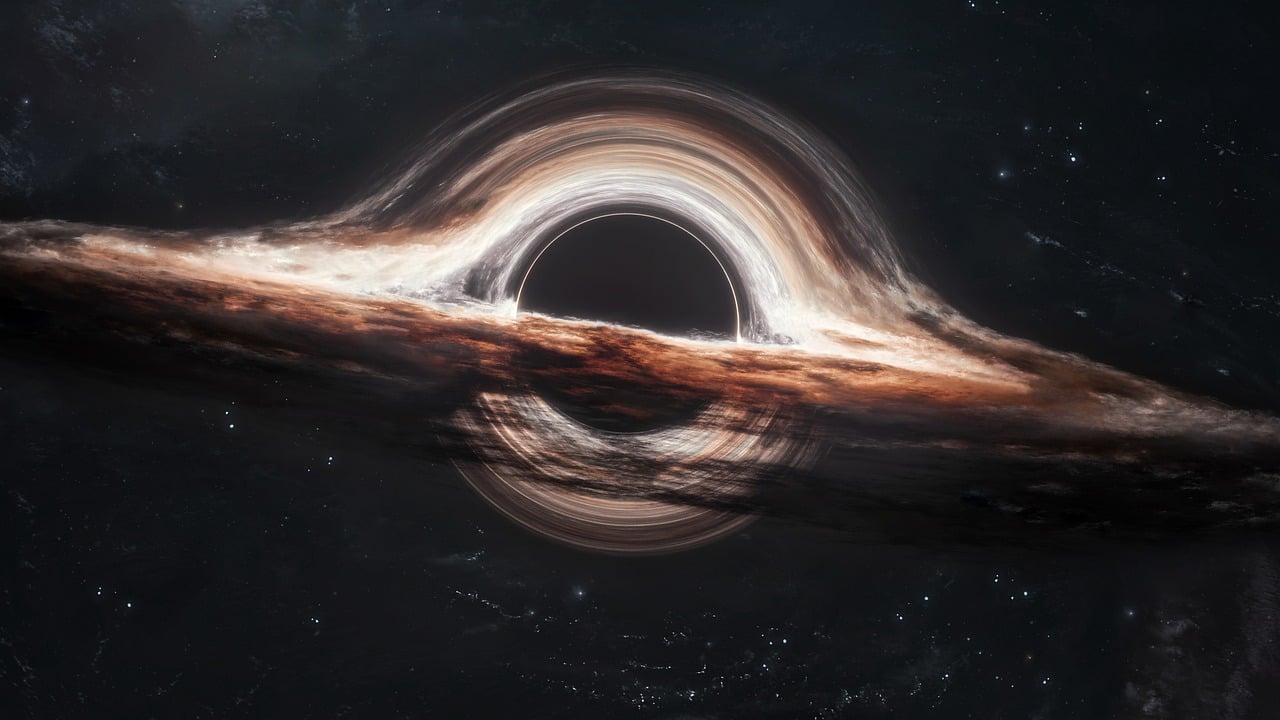
While black holes themselves emit no light, they reveal their presence through dramatic effects on their surroundings. Matter spiraling into a black hole forms an accretion disk a swirling maelstrom of gas heated to millions of degrees by friction and gravitational compression. These disks shine brilliantly in X-rays, making black holes some of the brightest objects in the universe despite their nature as ultimate darkness.
The physics of accretion disks is staggering. Gas orbiting close to a black hole can reach temperatures exceeding 10 million degrees Celsius hotter than the core of our Sun. Material in the inner disk whips around at significant fractions of light speed, completing an orbit in mere minutes despite traveling distances of millions of kilometers. The friction generated in these disks converts matter to energy with an efficiency of up to 40% far more efficient than nuclear fusion, which manages only about 0.7%. This is why quasars, powered by supermassive black holes gorging on matter, can outshine entire galaxies containing hundreds of billions of stars.
We can also detect black holes through their gravitational influence on nearby stars. Astronomers observe stars orbiting invisible companions, their motions revealing the presence of dark, massive objects. The star S2, for instance, orbits Sagittarius A* so closely that it reaches speeds of 7,650 kilometers per second 2.5% the speed of light. Its 16-year elliptical orbit takes it within 17 light-hours of the event horizon, close enough that we can measure the relativistic effects predicted by Einstein.
In 2019, the Event Horizon Telescope collaboration achieved what was once thought impossible: capturing an image of a black hole’s shadow. This wasn’t a single telescope but a planet-spanning network of radio dishes, effectively creating a telescope the size of Earth. The target, M87*, a supermassive black hole 55 million light years away in the galaxy M87, appeared as a dark circle silhouetted against glowing gas, exactly as Einstein’s equations predicted.
The image revealed M87* to be truly gargantuan 6.5 billion times the mass of our Sun, with an event horizon nearly three times the size of Pluto’s orbit. The ring of light surrounding the dark shadow represents photons bent around the event horizon by the black hole’s intense gravity, some completing multiple orbits before escaping to our telescopes. The asymmetric brightness of the ring reveals the black hole’s rotation the brighter side shows matter moving toward us at relativistic speeds, its light boosted by the Doppler effect.
In 2022, the same team unveiled an image of our own galactic center’s black hole, Sagittarius A*. Though much smaller than M87*, imaging it proved more challenging. Matter orbits Sgr A* in mere minutes rather than weeks, meaning the black hole’s “face” changes faster than we can photograph it like trying to get a clear picture of a fidgeting toddler with a long exposure.
Perhaps most intriguing are the jets launched by some black holes narrow beams of particles and radiation that extend thousands or even millions of light-years into space. These jets, powered by magnetic fields tangled in the swirling accretion disk, shoot matter outward at speeds exceeding 99.9% the speed of light. The jet from M87* stretches 5,000 light-years from the black hole, visible even in amateur telescopes. How black holes, known for their inescapable gravity, can also launch the most powerful outflows in the universe remains an active area of research.
Gravitational Waves: Ripples in Spacetime
The 2015 detection of gravitational waves by LIGO opened an entirely new window onto black holes and earned the 2017 Nobel Prize in Physics. When two black holes spiral together and merge, they create ripples in spacetime itself that propagate outward at the speed of light. These waves carry information about the merger, revealing the masses and spins of the colliding black holes and confirming predictions made by Einstein over a century ago.
The first detected merger, designated GW150914, involved two black holes of 29 and 36 solar masses colliding 1.3 billion light-years away. In the final fraction of a second before merger, they orbited each other 250 times per second, whipping around at half the speed of light. The collision released more energy in gravitational waves than all the stars in the observable universe were emitting in light at that moment. Yet the ripples in spacetime that reached Earth were incredibly tiny—LIGO had to measure changes in length smaller than one ten-thousandth the diameter of a proton.
To put this sensitivity in perspective, imagine measuring the distance to the nearest star, Alpha Centauri (4.37 light-years away), with an accuracy equal to the width of a human hair. That’s the precision required to detect gravitational waves. LIGO achieves this using laser interferometry in vacuum chambers stretching four kilometers, isolated from every conceivable source of noise—from truck traffic on distant highways to quantum fluctuations in the laser light itself.
Since that first detection, LIGO and its European counterpart Virgo have observed dozens of black hole mergers, revealing a diverse and surprising population. We’ve detected black holes merging that are much heavier than we thought stellar collapse could produce. We’ve seen wildly spinning black holes and strangely still ones. We’ve caught black holes with mass ratios of 10:1, mergers that produce violent, asymmetric bursts of gravitational radiation.
One of the most extraordinary detections came in 2019: GW190521, the merger of two black holes weighing 85 and 66 solar masses, creating a 142-solar-mass black hole. This event was special for two reasons. First, the 85-solar-mass black hole shouldn’t exist—stellar evolution theory predicts a “mass gap” where such black holes can’t form from dying stars. Second, the resulting 142-solar-mass black hole was the first clear detection of an intermediate-mass black hole, a long-sought missing link in black hole evolution.
The merger itself released the energy equivalent to eight solar masses meaning eight times the mass of our Sun was converted entirely into gravitational wave energy according to Einstein’s E=mc². This happened in less than a tenth of a second, a cosmic explosion of spacetime itself.
Gravitational waves allow us to detect black hole collisions across the entire observable universe. As detectors become more sensitive, we expect to observe thousands of mergers per year, mapping the population of black holes throughout cosmic history and potentially revealing entirely new phenomena perhaps even the collisions of primordial black holes formed in the first second after the Big Bang.
The Information Paradox and Quantum Mysteries
Black holes pose profound questions for fundamental physics that touch the very foundations of reality. When matter falls into a black hole, what happens to the information it contains the quantum states that define every particle’s properties? According to quantum mechanics, information cannot be destroyed; it must be preserved in some form. Yet anything crossing the event horizon seems to vanish forever, inaccessible even in principle.
This “information paradox” has driven decades of theoretical work and represents one of the deepest conflicts between quantum mechanics and general relativity. Stephen Hawking first formulated the paradox in the 1970s after his own groundbreaking discovery that black holes aren’t entirely black.
Hawking realized that quantum effects near the event horizon cause black holes to emit radiation a process now known as Hawking radiation. According to quantum field theory, particle-antiparticle pairs constantly pop in and out of existence throughout space. Near a black hole’s event horizon, one particle can fall in while the other escapes. To a distant observer, it appears that the black hole is emitting particles and slowly evaporating.
The evaporation process is extraordinarily slow. A black hole with the mass of our Sun would take about 10^67 years to completely evaporate far longer than the current age of the universe (13.8 billion years). The temperature of such a black hole would be a mere 60 nanokelvins, far colder than the cosmic microwave background radiation filling space. For a black hole to evaporate faster than it grows from absorbing cosmic background radiation, it would need to be smaller than the Moon and no known process can create such tiny black holes, though they might have formed in the extreme conditions of the early universe.
Stellar-mass black holes would take 10^68 years to evaporate, while supermassive black holes would require 10^100 years or more a timescale so vast it makes the current age of the universe seem like the blink of an eye. Yet the paradox remains: if Hawking radiation is random and carries no information, how is the information about everything that fell into the black hole preserved?
Recent theoretical work suggests that information might be encoded in subtle correlations within the Hawking radiation, retrievable in principle though not in practice. Others propose that information is stored at the event horizon itself, encoded holographically on the two-dimensional surface. The holographic principle suggests that all the information in a three-dimensional region of space can be described by data on its two-dimensional boundary—an idea with profound implications for the nature of reality itself.
Some theorists even question whether event horizons exist at all, proposing instead “fuzzballs” or “firewalls” exotic quantum structures that would fundamentally change our picture of black holes. Resolving the information paradox may require a complete theory of quantum gravity, merging general relativity and quantum mechanics in ways we don’t yet understand.
Journey to the Singularity: What Would Happen If You Fell In?
Imagine you’re an astronaut approaching a stellar-mass black hole—say, one with ten times the mass of our Sun. Your experience would be profoundly different depending on whether you’re the one falling in or watching from a safe distance.
From your perspective as the falling astronaut, you would notice the black hole’s gravity pulling unevenly on your body. Your feet, being closer to the event horizon, would feel stronger gravity than your head a difference that grows rapidly as you fall. This tidal force, called “spaghettification,” would stretch you vertically while compressing you horizontally. For a stellar-mass black hole, these tidal forces become lethal long before you reach the event horizon. You would be torn apart, your atoms ripped from their molecular bonds, stretched into a thin stream of plasma falling toward the singularity.
But here’s the strange part: you would cross the event horizon without feeling anything special at that exact moment. The event horizon isn’t a physical surface or barrier it’s simply the mathematical boundary where escape becomes impossible. If the black hole were supermassive enough billions of solar masses the tidal forces at the event horizon would be gentle enough that you could cross it alive and intact, oblivious to your doom.
Once across, you would have only seconds or minutes before reaching the singularity, depending on the black hole’s size. During this time, your view of the universe would become increasingly bizarre. Looking backward toward the event horizon, you would see a bright ring all the light from the outside universe compressed into an ever-shrinking circle. Looking forward toward the singularity, you would see… we don’t know. Our equations break down at the singularity where density becomes infinite.
Your friend watching from a safe distance would see something entirely different. As you accelerate toward the event horizon, they would see you moving slower and slower, your image becoming increasingly redshifted as the black hole’s gravity stretches the light waves leaving your body. Clocks on your spacecraft would appear to tick slower and slower. You would appear to freeze at the event horizon, your image fading to dark red and then to invisibility as the light becomes infinitely redshifted. Your friend would never see you actually cross from their perspective, you would hover at the event horizon for eternity.
This is one of the most counterintuitive aspects of black holes: both perspectives are equally valid. You experience crossing the event horizon and reaching the singularity in finite time by your clock. Your friend never sees you cross. This isn’t a contradiction it’s a consequence of how extreme gravity warps spacetime itself.
If you fell into a rotating black hole and all realistic black holes rotate the interior becomes even stranger. Between the outer event horizon and an inner horizon lies the ergosphere, where spacetime itself is dragged around the black hole. Here, standing still becomes impossible; you must move in the direction of the black hole’s rotation even if you fire your rockets at full power in the opposite direction.
Some solutions to Einstein’s equations suggest that rotating black holes might contain passages to other regions of spacetime wormholes leading to other universes or other locations in our own universe. But these solutions are likely unstable; the passage would collapse before anything could traverse it. Nature probably doesn’t provide such convenient cosmic shortcuts.
The inside of a black hole remains one of the most profound mysteries in physics. What actually exists at the singularity? Does quantum gravity smooth out the infinite density into something more comprehensible? Do the laws of physics break down completely, or transform into something we don’t yet understand? These questions await a theory of quantum gravity to answer.
Engines of Creation and Cosmic Sculptors
Far from being merely destructive, black holes play crucial roles in cosmic evolution, acting as both creation engines and galactic architects. The supermassive black holes at galaxy centers don’t just destroy they regulate the very process of star formation throughout their host galaxies.
When a supermassive black hole feeds, consuming gas and stars, it doesn’t do so quietly. The accretion process generates powerful jets and winds that blast outward with tremendous force, plowing into surrounding gas clouds and heating them to temperatures too high for stars to form. This “feedback” prevents gas from cooling and collapsing too rapidly into stars. Without this regulation, galaxies would burn through their gas reserves far too quickly, creating a universe radically different from the one we observe.
Remarkably, astronomers have discovered a correlation between the mass of a galaxy’s central black hole and properties of the galaxy itself particularly the velocity of stars in its central bulge. A typical supermassive black hole contains about 0.1% of its galaxy’s total stellar mass, a suspiciously precise ratio that suggests a deep connection between black hole growth and galaxy evolution. The black hole and its host galaxy appear to grow together, each influencing the other’s development across billions of years.
The jets launched by some black holes can extend for millions of light-years, far beyond their host galaxies. The galaxy M87, home to the first black hole ever imaged, shoots a jet extending 5,000 light-years. Other black holes produce jets visible across half the universe. These jets can trigger star formation in gas clouds they encounter, seeding new generations of stars far from the black hole itself.
In galaxy clusters the largest gravitationally bound structures in the universe supermassive black holes prevent runaway cooling. X-ray observations reveal enormous cavities blown in the hot gas pervading these clusters, bubbles inflated by black hole jets like cosmic balloons. Without this heating, the gas would cool and collapse, forming trillions of new stars. Instead, black holes maintain a delicate balance, regulating the energy budget of the largest structures in the cosmos.
Black holes also serve as natural particle accelerators, far more powerful than anything we can build on Earth. The jets from active black holes accelerate particles to energies exceeding what’s achievable at the Large Hadron Collider by factors of millions. Some astronomers suspect that the highest-energy cosmic rays—particles that strike Earth’s atmosphere with energies equivalent to a well-hit tennis ball compressed into a single proton originate from supermassive black hole jets.
Even black hole mergers may trigger star formation. The gravitational waves from colliding black holes ripple outward through their host galaxy, potentially compressing gas clouds enough to initiate stellar birth. In this way, the universe’s most violent events may seed creation itself.
Looking Forward: The Next Frontier
The study of black holes has progressed from mathematical curiosity to observational science in just over a century. When Karl Schwarzschild first solved Einstein’s equations in 1916 to describe what we now call a black hole, he was solving an abstract mathematical problem while serving in the German army during World War I. He died that same year, never knowing that his “Schwarzschild radius” would become synonymous with the event horizon of one of nature’s most extreme objects.
For decades, black holes remained theoretical curiosities. Many physicists, including Einstein himself, doubted they could actually exist in nature. It wasn’t until the 1960s, with the discovery of quasars and X-ray binary stars, that evidence began mounting for the reality of these objects. Now, barely sixty years later, we’ve photographed them, detected their collisions, and mapped their distribution across cosmic time.
As gravitational wave detectors grow more sensitive, we will probe deeper into these cosmic abysses. LIGO is undergoing upgrades that will double its sensitivity, allowing it to detect black hole mergers from farther across the universe and revealing fainter events. The planned space-based LISA (Laser Interferometer Space Antenna) detector, scheduled to launch in the 2030s, will observe a completely different class of gravitational waves: those from supermassive black hole mergers and other sources invisible to ground-based detectors.
LISA will detect the mergers of supermassive black holes weighing millions to billions of solar masses cosmic collisions that shake the fabric of spacetime across the universe. These mergers occur when galaxies collide, their central black holes eventually spiraling together over millions of years. LISA will also search for primordial black holes, hypothetical objects that might have formed in the first fraction of a second after the Big Bang from density fluctuations in the nascent universe.
The Event Horizon Telescope continues to improve, with more radio dishes joining the global network. Future observations will capture movies rather than still images of black holes, revealing how matter flows in the extreme gravity near the event horizon. The telescope may also image the black hole in the galaxy Centaurus A, observe flares and eruptions from Sagittarius A*, and potentially capture jets being launched in real-time.
The next generation of X-ray telescopes will study accretion disks with unprecedented detail, testing general relativity in the strongest gravitational fields accessible to observation. They’ll measure the spins of black holes by observing how rotating black holes drag spacetime around with them the “frame-dragging” effect predicted by Einstein but only recently confirmed.
We may discover new types of black holes entirely. Primordial black holes could range from less than a gram to thousands of solar masses, and some theories suggest they might constitute the mysterious dark matter that outweighs visible matter five-to-one in the universe. Future observations might reveal intermediate-mass black holes in globular clusters or wandering through the galaxy, orphaned when smaller galaxies were torn apart.
One of the most exciting prospects is testing whether alternatives to black holes could exist. Some theories predict “gravastars,” “boson stars,” or other exotic objects that might mimic black holes without true event horizons. Distinguishing these from genuine black holes will require precision observations of how matter behaves at the very edge of the event horizon measurements now becoming possible with our newest instruments.
Perhaps most intriguingly, black holes may serve as natural laboratories for physics beyond our current understanding. Some theories suggest that quantum gravity effects might be detectable in the radiation from very small black holes or in the details of how black holes ring like bells after mergers. Observing such effects would revolutionize physics, merging quantum mechanics and gravity in ways that could reshape our understanding of space, time, and matter itself.
We might even use black holes as tools. Proposals exist for extracting energy from rotating black holes through the Penrose process, where objects dropped into the ergosphere—a region just outside the event horizon can emerge with more energy than they entered with, stealing rotational energy from the black hole itself. While purely theoretical, such ideas hint at how advanced civilizations might harvest energy from the cosmos.
The Ultimate Question
Black holes remind us that the universe is far stranger than everyday experience suggests. They are laboratories where gravity becomes strong enough to dominate all other forces, where time dilates to infinity, and where the laws of physics approach their limits. In studying these extreme objects, we push toward a more complete understanding of reality itself one that encompasses the universe’s most violent and mysterious phenomena.
Yet for all we’ve learned, fundamental questions remain. What happens at the singularity, where density becomes infinite and our equations break down? Do black holes eventually evaporate completely, and if so, where does their information go? Could naked singularities exist singularities without event horizons, violating the cosmic censorship hypothesis that protects the universe from such mathematical absurdities? Could black holes be portals to other universes or other regions of spacetime?
As we peer deeper into these cosmic abysses with ever-more sophisticated instruments, we inch closer to answers. Each discovery raises new questions, pulling us further into the mystery. Black holes stand as monuments to the power of human curiosity and the mathematical beauty of the universe. They began as seemingly absurd predictions of Einstein’s equations and have become cosmic reality a reminder that the universe is often stranger and more wonderful than we dare imagine.
The journey to understand black holes continues, and the most exciting discoveries may still lie ahead, waiting at the edge of darkness where physics, imagination, and reality converge.