
On Christmas morning 2021, humanity launched its most ambitious eye into the cosmos. The James Webb Space Telescope a technological marvel three decades in the making lifted off from French Guiana, carrying with it a promise: to see what has always been hidden. For thirty years, the Hubble Space Telescope had been our window to the universe, capturing images of breath-taking beauty and scientific significance. But Hubble, for all its achievements, could only see so far. There were cosmic secrets lurking just beyond its reach, veiled in dust and stretched by the expansion of space itself.
Webb doesn’t replace Hubble, it completes it. Where Hubble sees in visible light, Webb peers through infrared wavelengths, pulling back curtains that have shrouded the universe’s deepest mysteries since the beginning of time.
The Universe’s First Light
Perhaps Webb’s most stunning revelation is its glimpse of cosmic dawn the era when the first stars ignited in the primordial darkness. These ancient galaxies, born just 300 million years after the Big Bang, have been hiding in plain sight for 13.5 billion years. Their light, stretched by the universe’s expansion into infrared wavelengths, was invisible to Hubble’s eyes.
The discovery of galaxy JADES-GS-z14-0 sent shockwaves through the astronomical community. Astronomers found a galaxy over 1,600 light-years across, containing stars equivalent to 400 million times the mass of our Sun all formed in a cosmic eyeblink. According to current cosmological theory, there shouldn’t have been enough matter in the universe at that time to build something so massive so quickly. Yet there it is, blazing in Webb’s infrared vision, impossibly bright and defiantly blue.
These early galaxies present a puzzle wrapped in an enigma. They’re shockingly bright, unexpectedly massive, and strangely dust-free. When galaxies grow, their stars explode as supernovas, creating dust that typically makes galaxies appear red. But Webb shows these cosmic infants glowing blue pristine and unobscured. Some astronomers wonder if these ancient suns formed differently, perhaps as massive stars that simply collapsed under their own gravity without the dramatic supernova explosions we see today.
Piercing the Veil of Stardust
Stars are born in chaos within massive clouds of gas and dust that collapse under their own gravity. For decades, these stellar nurseries have frustrated astronomers. Visible light, the wavelengths Hubble observes, bounces off dust particles like headlights in fog. The result? Dark, impenetrable clouds where the most fascinating cosmic events occur just out of sight.
Webb changes everything. Infrared light, with its longer wavelengths, slips through dust like a knife through silk. The telescope’s infrared vision has revealed thousands of new born stars buried deep within the Eagle Nebula’s famous Pillars of Creation stars Hubble never knew existed. In the Rho Ophiuchi complex, Webb unveiled dozens of young low-mass stars along with the jets they emit, illuminating surrounding clouds of molecular hydrogen in exquisite detail.
The Ring Nebula, long admired in Hubble’s images, reveals its true complexity through Webb’s infrared eyes. Beyond the familiar ring lie ten concentric arcs ghostly shells of gas expelled by the dying star at intervals over millennia. These arcs likely formed when ejected material interacted with a distant companion star, creating ripples in space like stones dropped in a cosmic pond.
Worlds Beyond Our Solar System
For the first time in human history, we’re analysing the atmospheres of planets orbiting distant stars searching for the chemical signatures that might indicate life. Webb’s spectroscopic instruments can detect molecules in exoplanet atmospheres by analysing how starlight filters through them during transits.
K2-18 b, a planet 120 light-years away, has emerged as one of the most intriguing candidates for habitability. Webb’s observations support the hypothesis that it’s a “Hycean world” an ocean planet with a thick, hydrogen-rich atmosphere. The data shows abundant methane and carbon dioxide but little ammonia, a chemical profile consistent with liquid water beneath a protective atmospheric blanket. While this doesn’t prove life exists there, it demonstrates that Webb can identify potentially habitable environments across interstellar distances.
Webb has helped astronomers confirm the existence of over 5,600 exoplanets, expanding our understanding of planetary systems beyond the Milky Way. Each discovery brings us closer to answering one of humanity’s most profound questions: Are we alone?
The Infrared Advantage
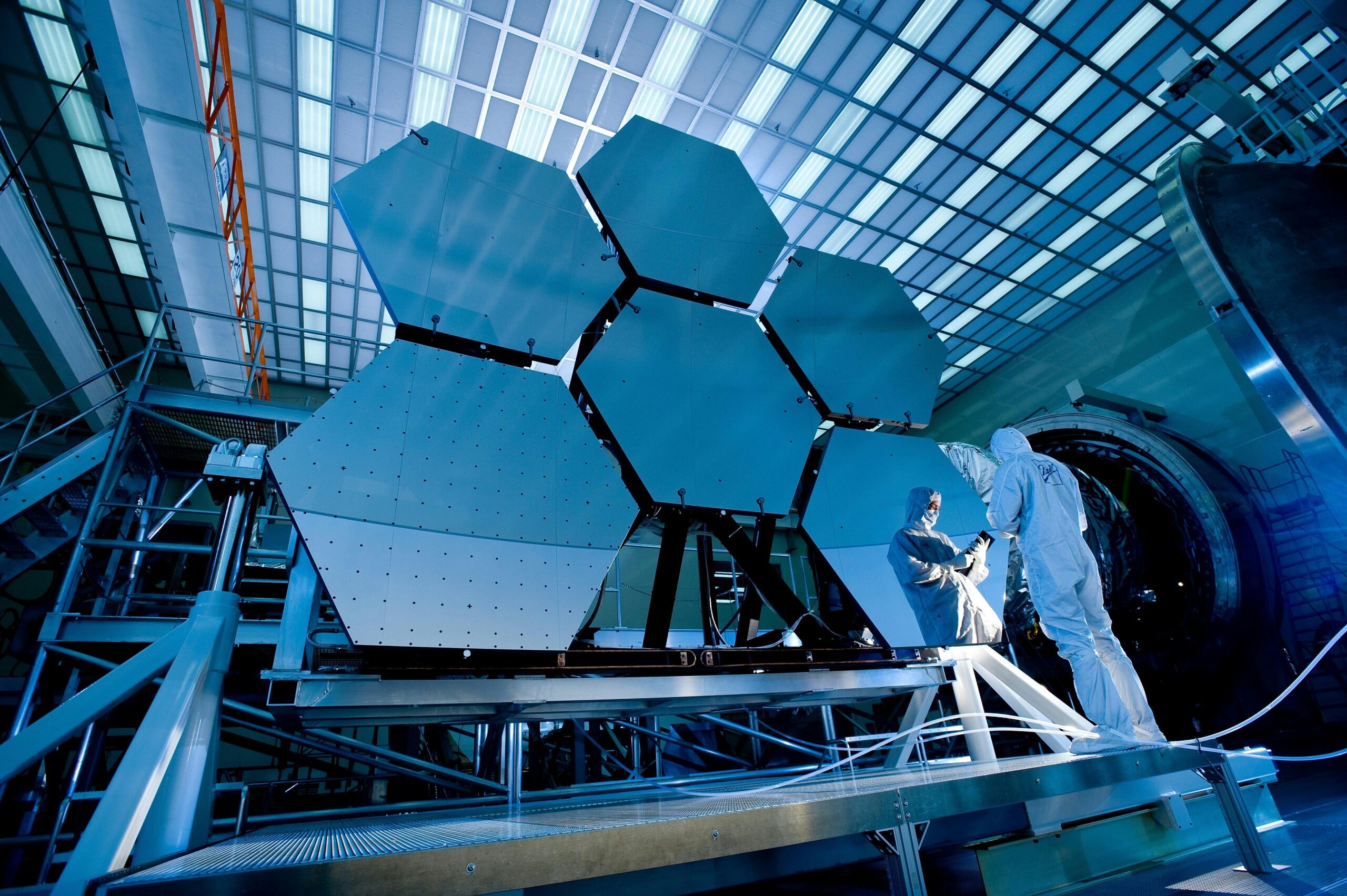
Webb’s revelations stem from a fundamental shift in how we observe the universe. While Hubble’s 2.4-meter mirror captured visible and ultraviolet light, Webb’s 6.5-meter mirror composed of 18 gold-plated beryllium hexagons collects infrared radiation across a much broader spectrum. This isn’t just about seeing farther; it’s about seeing differently.
Objects in space that are too cool to emit much visible light brown dwarfs, young proto stars forming in nebulae, planets in other solar systems glow brightly in infrared. Meanwhile, cosmic expansion stretches the ultraviolet and visible light from the universe’s earliest galaxies into infrared wavelengths through a process called cosmological redshift. The farther away an object is, the more its light is stretched, and the older it is. For Webb, looking deeper into space truly means looking farther back in time.
To capture this ancient, faint infrared light, Webb must operate at temperatures below 50 Kelvin colder than the dark side of Pluto. A five-layer sunshield the size of a tennis court, with the protective power of SPF 1 million, keeps the telescope frigid by blocking radiation from the Sun, Earth, and Moon. Positioned at the second Lagrange point, 1.5 million kilometres from Earth, Webb orbits the Sun in sync with our planet, maintaining its icy vigil at the edge of space.
Breaking the Rules of Cosmology
Some of Webb’s most perplexing discoveries challenge our understanding of how the universe evolved. Astrophysicist Erica Nelson spotted them first: six “fuzzy dots” of light in Webb’s Cosmic Evolution Early Release Science survey, glowing impossibly bright and red against the darkness. These candidate galaxies may have existed just 500 to 700 million years after the Big Bang, yet calculations suggest they contain almost as many stars as the modern Milky Way packed into spaces thirty times smaller.
“If even one of these galaxies is real,” Nelson noted, “it will push against the limits of our understanding of cosmology.” The discoveries sparked headlines about the universe being “broken,” but subsequent analysis suggests more prosaic explanations. Still, Webb continues to find massive, bright galaxies in eras where they shouldn’t exist cosmic anomalies that demand new theories or force us to reconsider old ones.
A Golden Age of Discovery
Webb and Hubble now work in tandem, their complementary visions providing unprecedented views of cosmic phenomena. Hubble’s visible and ultraviolet observations combined with Webb’s infrared insights offer complete spectral coverage of everything from nearby galaxies to the most distant objects in the universe. Together, they’re ushering in what many astronomers call a new golden age of astronomy.
The telescope’s mission, originally designed for five to ten years, now has enough fuel to operate for over two decades. Scientists have only begun to mine the treasure trove of data Webb produces. Each observation opens new questions: How did supermassive black holes form so early in cosmic history? Why are the first galaxies so different from what we predicted? What chemistry occurs in the atmospheres of distant worlds? Could some harbour life?
“The telescope is more powerful than anything we’ve ever had,” said Nobel laureate John Mather, Webb’s senior project scientist. “I’m eager to see the surprises. I feel pretty sure that we’re going to see something that nobody even dreamed was there.”
Three years into its mission, Webb has already transformed our cosmic perspective. It has shown us galaxies from cosmic dawn, revealed stellar nurseries hidden in dust, and analyzed alien atmospheres light-years away. Yet perhaps its greatest contribution is teaching us humility reminding us that the universe holds mysteries we haven’t even imagined. Behind every cosmic veil Webb pierce, another appears, beckoning us deeper into the unknown.
The infrared universe, once invisible, now blazes with secrets waiting to be discovered. And we have only just begun to look.