
A red supergiant on the edge of our cosmic neighbourhood may explode in our lifetimes or not for another 100,000 years
High in the winter sky, marking the shoulder of the constellation Orion the Hunter, shines one of astronomy’s most captivating enigmas. Betelgeuse, a name derived from Arabic meaning “the hand of Orion,” is a star that shouldn’t make sense by the rules of our sun. It’s a cosmic behemoth in its death throes, and astronomers are watching its final act with unprecedented detail.
A Star of Superlatives
If you could pluck Betelgeuse from its position some 650 light years away and place it where our sun sits, its surface would extend past the orbit of Mars, swallowing Mercury, Venus, Earth, and the Red Planet whole. This red supergiant boasts a diameter roughly 900 times that of our sun, making it one of the largest known stars in our galaxy. Yet despite its enormous size, Betelgeuse weighs only about 16 to 19 times the mass of the sun, a testament to how incredibly diffuse its outer layers have become.
The star’s luminosity is equally staggering. On average, Betelgeuse pumps out about 100,000 times more energy than our sun, though this varies considerably as the star pulses and convulses through its final evolutionary stages. If it weren’t for the vast distance separating us, Betelgeuse would cast shadows at night and be visible even during daylight hours.
The Great Dimming Mystery
In late 2019, something strange happened. Betelgeuse, normally one of the ten brightest stars in Earth’s night sky, began to fade dramatically. By February 2020, it had dimmed to less than 40% of its normal brightness, a change visible to the naked eye that sparked headlines around the world. Was this the long-anticipated sign that the star was about to explode?
Astronomers mobilized telescopes across the globe and in space to solve the mystery. What they discovered was both mundane and extraordinary: Betelgeuse had essentially sneezed. The star had ejected a massive blob of material from its surface, which then cooled and condensed into a dust cloud that temporarily blocked our view of the star. High-resolution imaging from the Very Large Telescope in Chile and the Hubble Space Telescope revealed this obscuring cloud in stunning detail.
But the dimming revealed something deeper about Betelgeuse’s nature. The ejection was so powerful that it actually carried away a piece of the star’s visible surface, a patch of photosphere that took months to regenerate. This “surface mass ejection” was an unprecedented event, far more dramatic than anything observed on our own sun, and it offered scientists a real-time glimpse into the violent processes at work in a dying massive star.
The Supernova Clock
The question that captivates both astronomers and the public alike is deceptively simple: When will Betelgeuse explode? The answer is frustratingly imprecise: sometime in the next 100,000 years. It could happen tomorrow, or it could happen millennia after our civilization has vanished.
When Betelgeuse does finally detonate as a Type II supernova, the explosion will be spectacular. For weeks or even months, it will shine as brightly as the full moon in Earth’s sky, visible even in broad daylight. It will be the closest supernova humanity has witnessed since 1604, when Johannes Kepler observed a stellar explosion in our own galaxy. The event would transform our night sky, giving Orion a dazzling new jewel and providing astronomers with an unprecedented opportunity to study a supernova in real-time detail.
But there’s no need to worry about danger. At 650 light-years away, Betelgeuse is well beyond the approximately 50 light-year “kill radius” where a supernova’s radiation and energetic particles could significantly affect Earth’s atmosphere and biosphere. We’ll have a front row seat to one of nature’s most powerful explosions from a perfectly safe distance.
A Window into Stellar Death
What makes Betelgeuse so valuable to science isn’t just its inevitable spectacular demise, but what it’s teaching us right now about how massive stars die. The star is currently in the red supergiant phase, having already burned through the hydrogen in its core and moved on to fusing helium into carbon and oxygen. Soon, in astronomical terms, it will begin fusing carbon, then neon, then oxygen, and finally silicon.
Each successive stage burns faster and hotter than the last. While the star spent millions of years burning hydrogen, it will burn silicon for just a single day before the core collapses catastrophically, triggering the supernova explosion. In its core right now, Betelgeuse is essentially playing out the final moves in a game of cosmic chess where checkmate is inevitable.
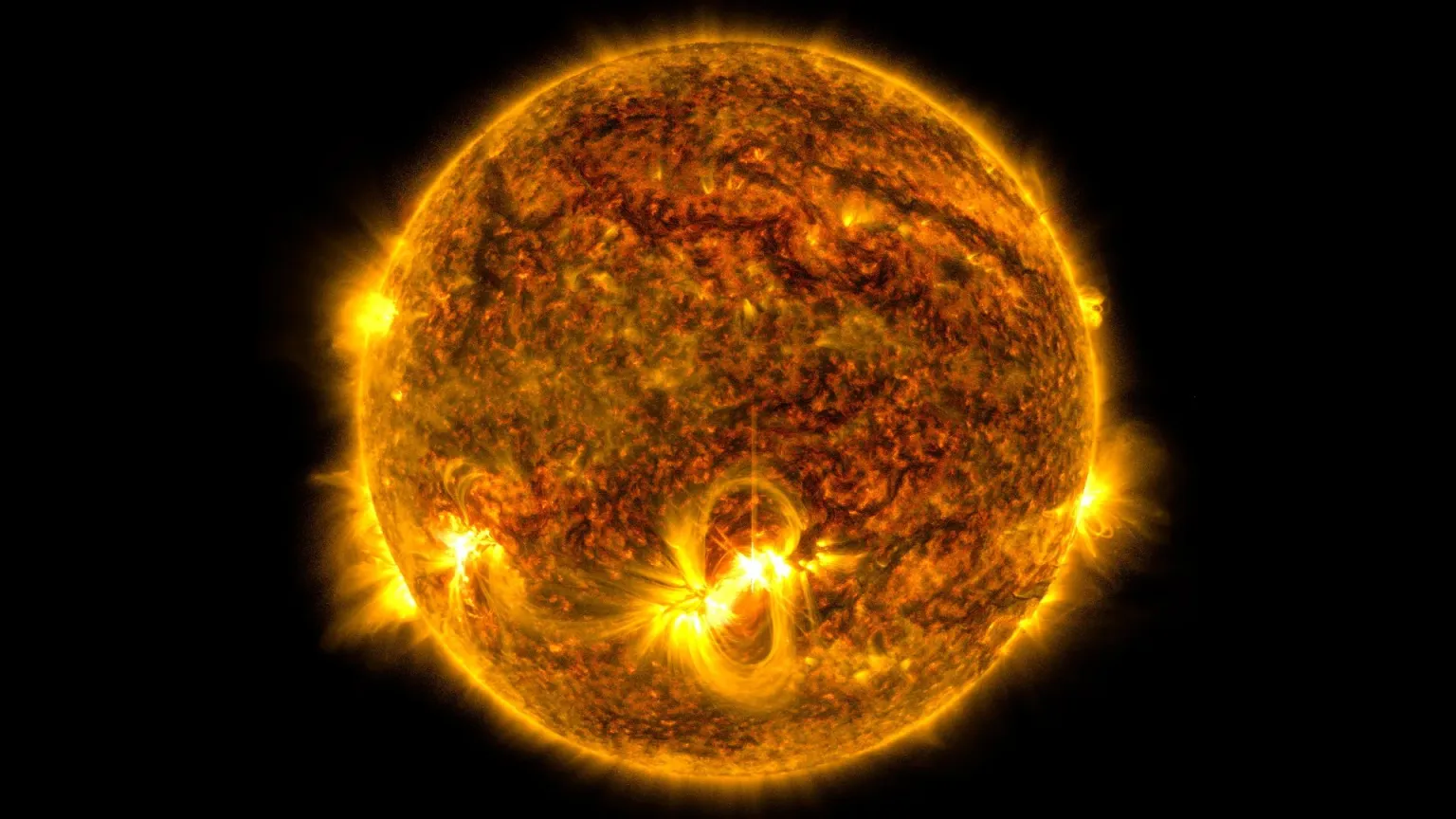
The star’s surface tells its own story. Advanced imaging techniques have revealed that Betelgeuse’s photosphere is covered in enormous convection cells, roiling patches where hot material rises from the interior and cooler material sinks back down. These cells are so large that just a few of them cover the entire visible surface. The star also shows massive prominences and ejections that dwarf anything seen on our sun, hurling material outward at speeds exceeding 30,000 kilometres per hour.
The Element Factory
When Betelgeuse explodes, it will do more than put on a spectacular light show. It will scatter elements across space that are essential for life as we know it. The star has been busy manufacturing heavy elements through nuclear fusion, but it’s the supernova explosion itself that will produce many of the heaviest elements in the periodic table through rapid neutron capture.
Gold, platinum, uranium, and many other elements heavier than iron were forged primarily in supernova explosions and the collisions of neutron stars. Every atom of calcium in your bones, iron in your blood, and gold in your jewellery was created in stellar furnaces and stellar explosions billions of years ago. Betelgeuse will someday enrich the interstellar medium with these elements, potentially contributing to new generations of stars and planets and perhaps even new forms of life.
Watching and Waiting
Today, Betelgeuse continues to be monitored by professional astronomers and amateur stargazers alike. The star’s complex pulsations, occasional dimming events, and surface activity are all pieces of a puzzle that will help us understand not just Betelgeuse, but all massive stars in their final evolutionary stages.
Advanced instruments like the Atacama Large Millimeter Array (ALMA) in Chile and the James Webb Space Telescope continue to study the star’s atmosphere, its surrounding nebula of ejected material, and the complex chemistry at work in its outer layers. Each observation adds to our understanding of stellar physics and helps refine models of how massive stars evolve and die.
Meanwhile, supernova detection networks around the world stand ready. When Betelgeuse finally does explode, we’ll know within hours, and telescopes across the electromagnetic spectrum will swing into action to capture every detail of the event. The neutrino burst from the collapsing core will actually arrive at Earth slightly before the visible light, giving us a few hours’ warning that the fireworks are about to begin.
A Cosmic Reminder
Betelgeuse serves as a reminder that even stars are not eternal. This giant that has blazed in our sky for tens of thousands of years, witnessed by every human civilization that has ever looked up at the winter sky, will one day vanish in a blaze of glory. When it does, the constellation Orion will be forever changed, and humanity will have witnessed one of nature’s most powerful events.
But perhaps more importantly, Betelgeuse reminds us of our connection to the cosmos. We are, quite literally, made of star stuff-atoms forged in stellar cores and scattered across the galaxy by supernova explosions just like the one Betelgeuse will eventually undergo. Looking up at that reddish point of light in Orion’s shoulder is looking at our own distant past and future, written in fire across the heavens.
Betelgeuse can be easily spotted with the naked eye as the reddish star marking the upper left corner of Orion, best viewed in winter months from the Northern Hemisphere. Keep watching you might just witness history.